
The ever-changing property landscape has dramatically shaped the private rental market and how each generation views homeownership. For landlords, the mix of unattainability due to low incomes and increased pricing and the new attitudes towards buying and owning a property has provided both challenges, changes, and, should you know where to look, new opportunities.
But before thinking about becoming a landlord, there are a few crucial factors to consider. These include things like landlord insurance and contracts. However, if you’re on the hunt for a new property to rent, you’re also going to want to understand the current property market to see a reasonable return on investment.
Why are more people renting?
Unlike Germany, which is predominately a nation of renters, getting on the property ladder has been instilled into Brits for decades.
Today, however, homeownership is becoming increasingly out of reach; with data from YouGov revealing this time last year, 1 in 6 Brits believed they’d never be able to afford their own home. For others, taking out a long-term mortgage is sometimes financially unappealing, with most mortgage terms averaging a minimum of 25 years. As a result, those who cannot afford to buy or don’t want to have either taken to trying through government schemes or turned to long-term renting.
Though rent can sometimes come close to being the same as the cost of mortgage repayments, there are many instances where renters either have no choice but to rent or opt to. Flexibility to move into a property that suits their needs at that specific moment in time can appeal to those who want to live in a particular area. While the short-term agreement means renters don’t have the long term commitment to paying a mortgage should they wish to move to another town, city or even another country or are just no longer able to afford to live there. Alternatively, tenants may find they cannot obtain a mortgage on their income, so long-term renting is the more straightforward solution.
Where are people choosing to rent?
Having a property to rent can afford you a passive income as a private landlords. The property essentially pays for itself; in some cases, it almost guarantees a higher return on investment, property market permitting. Diving into Google search data, we’ve found that searches for rooms/houses to rent in the following areas have grown significantly in the past three years.
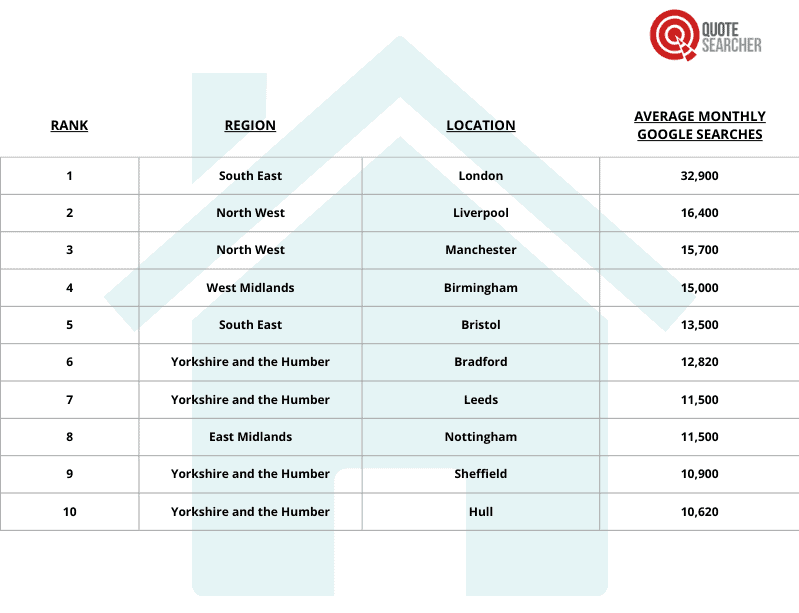
While London still comes up number 1 for where people are searching for somewhere to rent the most, the other major cities around the UK aren’t too far behind. Glasgow and Edinburgh miss out on the top 10, coming in 11th and 12th with average monthly searches totalling 10,500 and 10,200, respectively.
Is property a good investment?
Although the housing market is widely speculated, since January 2022, an additional 28% of Brits believe the average house price will rise next year, bringing the total to almost two thirds. Combining the top places that people look to rent, the best places to invest as a landlord and major UK cities, we have compiled a 12-year view of the average house prices* in 30 locations around the UK.
*based on a two bedroom house
https://public.flourish.studio/visualisation/9632605/
Despite being often ranked as one of the most expensive cities, house prices in both St Albans and Windsor stay ahead of London, leaving it in position four, as of January this year.
The best places to rent out your property
It really does pay to do your research when finding the right location for a buy-to-let property. While it ultimately comes down to what you can afford to buy, a few places stand out from the rest.
To identify some of the best places to invest, we looked at average house prices and rent to work out the annual rental yield you could expect on average from letting a property in that area.
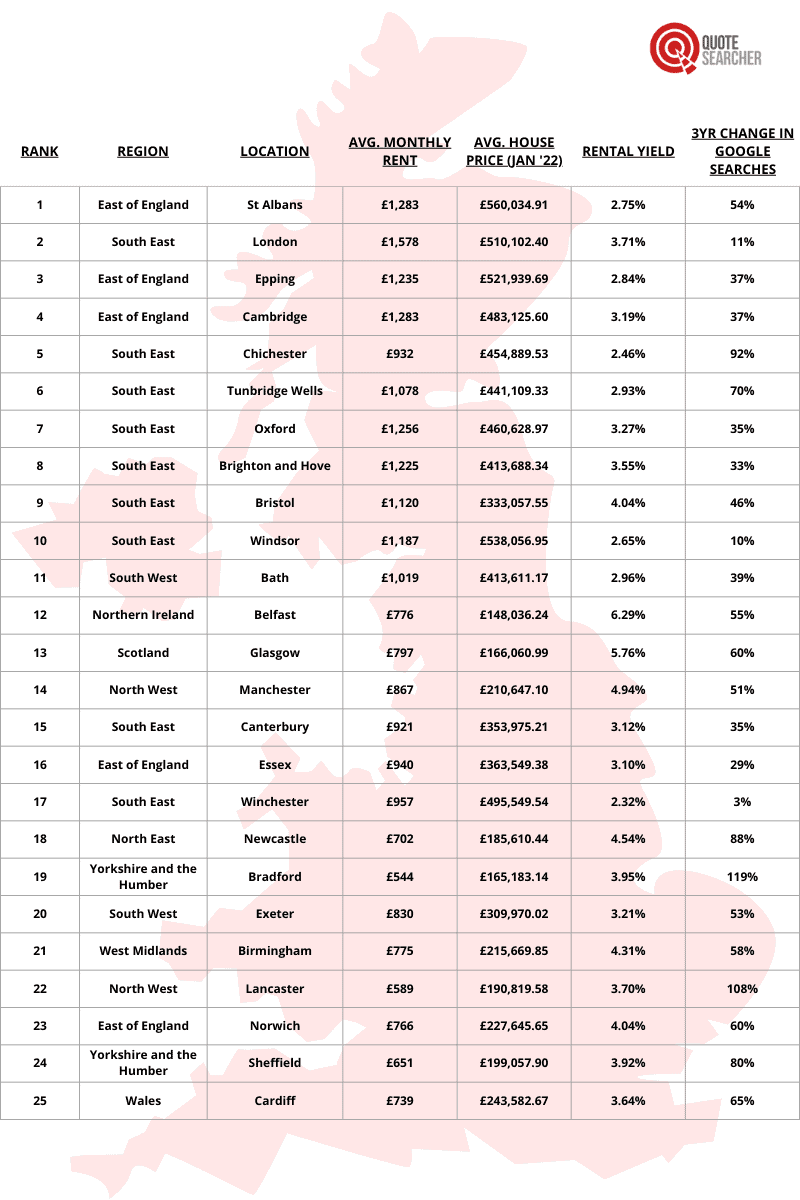
Looking into locations around the UK, St Albans ranks in the top position, above London, as a prime location for renting, with Google searches increasing by 54% over the past three years. Here an average 2-bed house could cost around £560,034.91- almost £100k more than they were valued at a decade ago.
Chichester comes in 5th with searches 92% higher this year vs three years ago, and Bradford in 19th with searches 119% higher and a rental yield of almost 4%.
Belfast is the only Northern Irish location to rank in the top 25 with the highest average rental yield of any area at 6.29% and a reasonable average house price of £148,036.24.
What else do you need to know?
For those looking for constant supply and demand, buying to let properties in university towns and cities offers consistent turn over of students seeking rooms and houses to rent for the duration of their studies.
However, in the past 5 years, just over half (51%) of enquiries for landlord insurance we’ve received have been for residential properties with renting specifically to professionals accounting for 4 in 5 of those. 10% have been for those on council support or asylum seekers. Prospective landlords looking to rent to students only accounted for 4% of the enquiries we received.
As a landlord, of course, you want to know that your property is going to make a decent return on investment, but outside of the income you could get, there are a few crucial factors that you need to be aware of, for example different types of tenants, and what to do about damage and what to include in tenancy agreements .
More information and help around landlord insurance can be found in our property guides.
Methodology:
Best places to be a landlord – Average house price and average monthly rent were sourced from the ONS, Stats Wales, Gov.scot and Gov.uk. Rental Yield was calculated by dividing average annual rent (monthly rent x 12) by the average house price for each specific location and converted into a percentage. Google search for ‘room to rent in X’ and ‘house to rent in X’ we sourced from Google Keyword planner between April 2019 and March 2022.
We then used a weighted rank for each data point to determine the overall top 25.
